
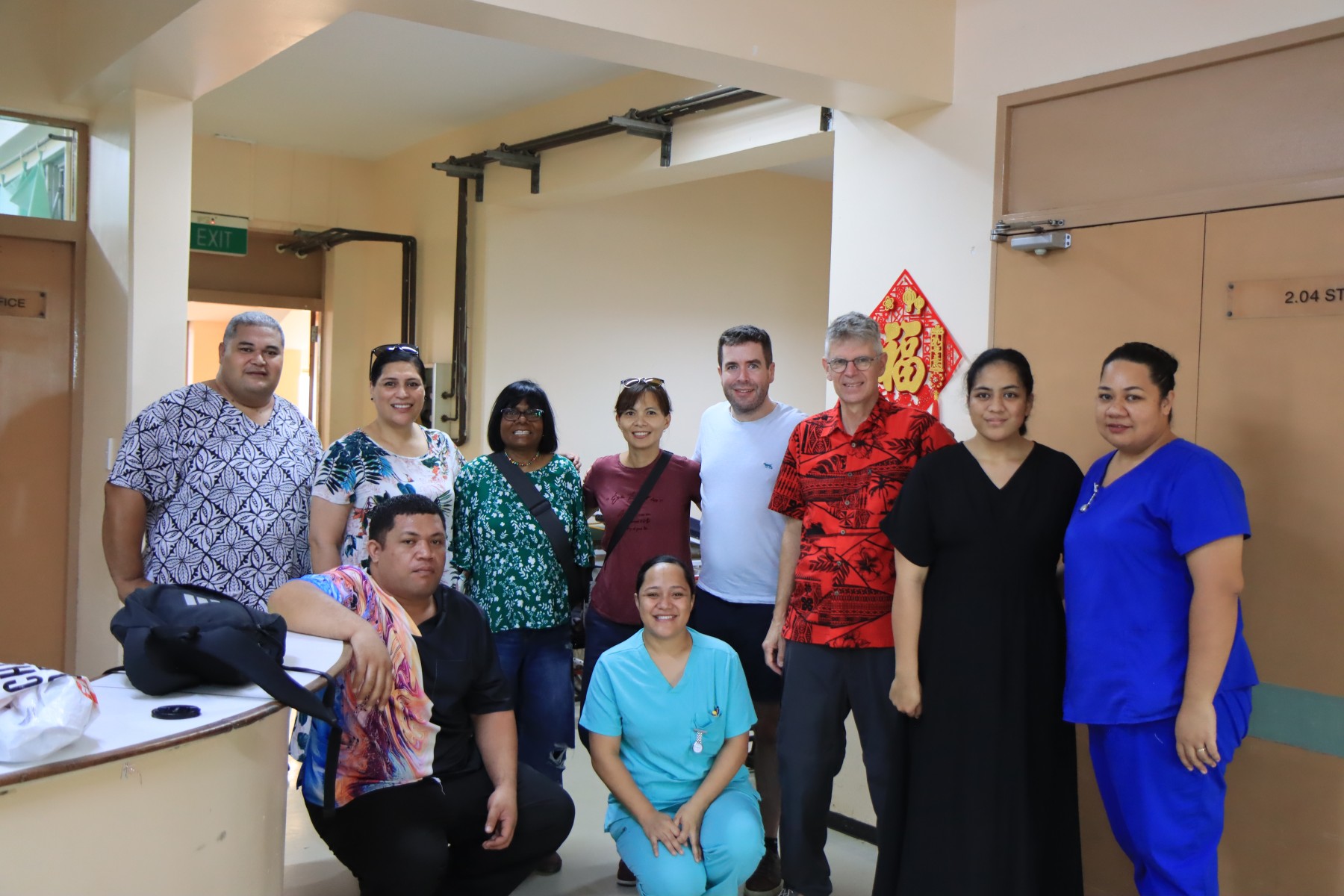
Consultant urologist, Associate Professor Dr Philip McCahy, who was part of the visiting team, said the programme is centred on partnership with the local health workforce.
“Urology has become very technology dependent, and the local team do not routinely have access to the equipment required for endourological procedures, especially the complex stones that are frequently seen on the islands. The local team are very good at diagnosing the problems, and we bring the skills and equipment to enable treatment of the patients.”
For many patients in Tonga, being able to access specialised surgery locally can make a significant difference to their health outcomes — 32 operations were successfully completed during the trip.
“For the majority of patients, the alternative to treatment from the Visiting Medical Team would be no treatment. That puts them at risk of developing end stage disease, which can often result in renal failure and an early death.
“Some lucky ones may be able to get to Australia or New Zealand for treatment, but they will be in the minority. The other great thing for the patients is that the treatment is free.”
While the visiting team performs a number of surgeries during each deployment, Dr McCahy said the programme is equally important for building long-term capability within the local health system.
Partnerships like this play an important role in strengthening surgical services across the Pacific, particularly in smaller countries where patient numbers may limit opportunities to develop expertise in highly specialised areas.
“With the correct support, they can deal with the important basics of most specialties. I have seen major developments in the time I have been coming to Tonga and, with the right support, I would hope the local surgeons will become mostly self-sufficient.”
Dr McCahy also expressed that the experience is valuable for visiting clinicians as well.
“It is important to recognise that the visiting team gain a lot from the trips too. Our skills are honed, we deal with some extremely complicated patients in a challenging environment, and we get to practise the medicine and surgery we trained for.
“It is a humbling experience coming to Tonga, and I am always extremely grateful. We are lucky to work with such lovely patients, colleagues and staff.”
Through initiatives such as the Visiting Medical Teams programme, partnerships between regional specialists and Pacific health systems continue to improve access to care while supporting the long-term development of local clinical capacity.
Supported by the New Zealand Ministry of Foreign Affairs and Trade and coordinated by the Pasifika Medical Association Group, the NZMTS remains dedicated to building resilient health systems and strengthening specialist capability across the Pacific.